



Legal framework: Safety is not optional
The legal requirements for cargo securing are clearly defined. Sections 22 and 23 of the German Road Traffic Regulations (StVO), VDI guideline 2700 ff., and the DIN standards EN 12195 explicitly state that cargo must remain in position under all normal transport conditions. These requirements apply not only to drivers, but to everyone involved in the transport process.
The vehicle body plays a key role here. Only when vehicle design and cargo are properly matched can these regulations be reliably fulfilled in practice.
Friction-based and form-fit cargo securing working together
On curtain-sided trailers, different securing methods are used in practice and complement each other depending on the type of load. With friction-based cargo securing, the load is held in place by frictional forces on the loading surface. By applying tie-down lashings, using anti-slip mats, and ensuring sufficient pre-tensioning force of the lashing equipment, load movement during transport is prevented. In addition, form-fit cargo securing is used, where the load is packed tightly against fixed boundaries such as the front wall, load beams, or blocking systems. This method is considered particularly effective and requires fewer lashing devices, but it depends on a sufficiently load-bearing vehicle structure and cannot be implemented for every load configuration. As a result, combined cargo securing – where friction-based and form-fit measures are purposefully combined – has become the state of the art in practice.
Proven in daily operation and certified: QuickCurtain in real transport use
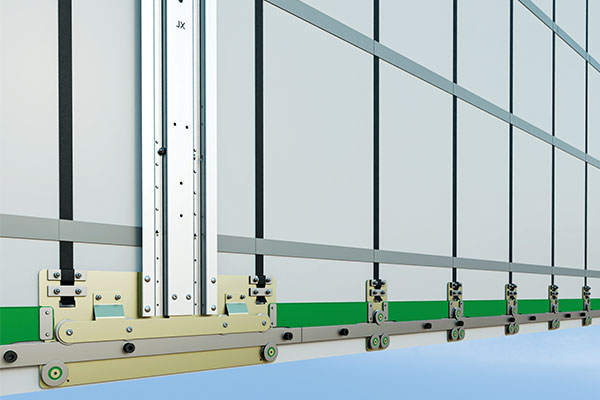
Especially in form-fit and combined securing concepts, the vehicle structure is a decisive factor. The Edscha TS QuickCurtain side curtain system has been tested and proven in demanding customer operations with a wide variety of loads. The system is certified by TÜV Nord in accordance with EN 12642 Code XL and includes dynamic testing for beverage transport. The lightweight yet robust design is partially based on flexible technical textiles that are specifically integrated into the load-bearing structure. This design combines high load capacity with low susceptibility to damage, supporting safe and practical cargo securing in everyday use.
EN 12642 XL: When the vehicle body itself provides safety
With the EN 12642 XL standard, the vehicle body itself becomes part of the cargo securing system. A semi-trailer with tarpaulin cover certified to XL is designed to absorb defined forces. This requires a structure that not only meets these loads in theory, but has also been tested under real conditions.
The roof system, in particular, becomes a focal point. Without sufficient roof reinforcement, XL certification is not achievable.
Roof reinforcement: Stability designed from above
Modern tarpaulin structures therefore rely on four- or eight-sided roof reinforcement systems using wire ropes or carbon-fiber-reinforced straps. These systems ensure even load distribution and stabilize the entire structure.
The roof is an active component of the vehicle body. It helps absorb lateral and vertical forces from the load and transfers them in a controlled manner into the structure – a decisive factor for safety and durability.
Edscha TS: Tarpaulin sliding roof systems with tested safety
The CS-Hybrid and CS-Profi tarpaulin sliding roof systems from Edscha Trailer Systems are consistently designed to meet these requirements. They were developed for tarpaulin structures in which the roof plays a load-bearing role for overall stability.
Both systems have successfully passed the load tests required by EN 12642 XL. Edscha TS places great emphasis on reproducible quality, robust materials, and a design that functions reliably even under real transport conditions.
Cargo securing requires multiple perspectives
Safe transport is the result of cooperation. Shippers plan the loading pattern, vehicle operators provide suitable equipment, and drivers check and monitor the securing throughout the journey. The roof system connects these levels and creates the technical basis for standards-compliant cargo securing.
This interaction is particularly evident with semi-trailers with tarpaulins: only a high-performance roof system turns the vehicle body into a reliable part of the securing concept.
Safety that is built in
With curtain-sided bodies, cargo securing does not start with lashing – it starts with the vehicle structure. Modern tarpaulin systems from Edscha TS play a key role here. With tested roof systems, well-engineered reinforcement, and consistent compliance with standards, Edscha TS solutions make a significant contribution to increased safety in everyday transport operations.